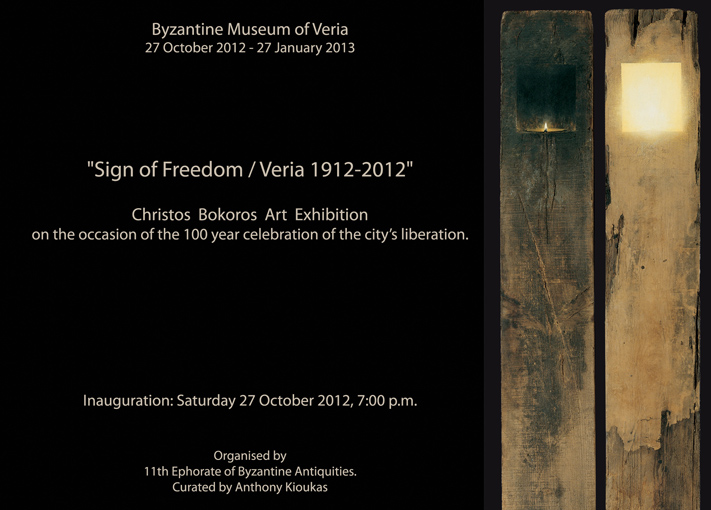
Veria, 16 October 1912. The Greek army bloodlessly enters the city. The Greek inhabitants see the Greek flag waving. ‘Sign of Freedom’.
… and though, in our days, flags may signify nationalisms and intolerances, collectivity will always find ways and symbols to save altruism and community throughout the history of lands. And though nations may become mixed, and their symbols may honour only those they were honoured by, let us not surrender to faceless companies the undertaking of man’s ultimate freedom: to envision and to substantiate the exalted and the worthy, to shape the standard of his life and his very own face. And, though today the precept ‘Freedom or Death’ seems futile—a dead body—, let us not forget that from Thermopylae and the Melians to Rhegas’s brave lads, the klephtes and the renegade rebels in the mountains, all the regulars and irregulars who fell for their country, selflessness and valour envisioned the freedom of the genuses and the places we still inhabit with that ultimate price in mind. Eternity is present in our own moment…
______________________________________________
For those who fell in the name of freedom
What does the precept ‘Freedom or Death’ sound like within an aggressively consumerist living condition? Robbed of meaning, a blank letter in our civilized world, a foolish demand, when it is not a cause of sheer embarrassment. Though it still rouses some downtrodden people to calmly demonstrate their relentless, silent resistance—that piece of their soul that cannot be bought out by the crippled freedom of the market. And, though today the precept seems futile—a dead body—, let us not forget that from Thermopylae and the Melians to Rhegas’s brave lads, the klephtes and the renegade rebels in the mountains, all the regulars and irregulars who fell for their country, selflessness and valour envisioned the freedom of the genuses and the lands we still inhabit with that ultimate price in mind.
Freedom of the market, freedom of choice, freedom of tourist and immigrant movement, freedom of comfort, freedom of unfettered acquisition of consumer goods and of their accumulation in vast dumping grounds: the many freedoms of rights demand nothing more than a financial price, they can only be appraised in
economic terms. They have substituted the difficult freedom of duties, toils and sacrifices. Death, as the ultimate price, has been exiled to the realms of ideological constructs and fictional fantasies, and when he does not arrive ‘due to natural causes’ in old age, we accept him only as an unfortunate coincidence of illnesses, accidents, addictions and weaknesses.
The era, whatever that may mean, has withdrawn its trust from the meaning of the value and the criterions of the exalted. It has also been a while since thought stopped accrediting art with the vocation of making the divine visible. My only resistance to the worsening amnesia of our time is remembrance. Within the exhaustively advertised bright oblivion, our dark memory lies latent. There, in remembrance’s darkened chamber, I sometimes light a candle. They also increase with time.
I insist on painting and on perceiving the artistic image as a visual revelation of a liturgical ethic. Our civilization is not the actual artworks, but the consciousness of their value; it is not the value of the objects themselves, but rather the collective value consciousness of the subject, namely, of each one of us who considers those objects. And, at this point, what emerges or what one is motivated to pursue, is the potential of an artwork to raise or uphold this consciousness, by exceeding definitions and its own self, to actually become a collective consciousness itself.
Even on the brink of wilderness and isolation, people and societies are recognized in relation to some other people and some other societies. They originate and they also surround others and co-exist with them: by nature and due to necessity. Pure individuality is a theoretical construction. Our individual adventure cannot be irrelevant to the world’s adventure. Our collective memory is our conceptual environment, our common code, our inner language. Thus, it seems self-evident to me to interchange with that memory, to define myself against it. It is the collective memory that communes one’s personal expression with their potential viewer, listener, or interlocutor. And though, in our days, flags may signify nationalisms and intolerances, collectivity will always find ways and symbols to save altruism and community throughout the history of lands. And though nations may become mixed, and their symbols may honour only those they were honoured by, let us not surrender to faceless companies the undertaking of man’s ultimate freedom: to envision and to substantiate the exalted and the worthy, to shape the standard of his life and his very own face. Eternity is present in our own moment.